Showing posts with label wealth. Show all posts

Sunday, September 27, 2015

The Parable of the Ditch Digger

Homme appuyé sur sa Beche (Jean-François Millet, c. 1848)

Let us consider the plight of the lowly ditch digger, the stereotypical example of the unskilled laborer. He is barely literate and so bereft of other talents that he is probably unemployable in any other vocation—or at least that’s the way many of us treat him. What is to become of such a marginal worker in our modern globalized economy?

“We must help the poor ditch digger,” says the altruist. “Society should provide him with food, housing, and medical care, so he can live in good health and security. We can’t let the wretch starve to death on the street while others live in luxury and dine upon the finest fare! Everyone must sacrifice to save this poor soul from himself.”

“No, no!” replies the interventionist. “Instead, the government should pay him to dig ditches and fill them in again. The money he spends will stimulate economic activity. No new goods or services will be produced, since we’ll only be moving resources around, but everyone will be employed.”

“I have a better idea,” offers the capitalist. “I could employ several ditch diggers on my construction projects. Their labor would add real value to my investments! I would pay them small wages, but they would enjoy honest remuneration, the dignity of productive work, and the opportunity to learn new workplace skills and advance their careers. If my investments succeed, there will be more goods and services available, and everyone will grow a little bit wealthier, including the ditch diggers.”

“You can’t pay him small wages!” the altruist says in horror. “How would he support his wife and children on such a pittance?”

“The ditch digger needs a fair wage—a living wage,” the interventionist adds. “The government should mandate minimum wages that guarantee workers won’t live in poverty.”

“Frankly,” the capitalist responds, “his labor isn’t worth more than that. If higher wages were mandated, I would be better off dismissing the ditch diggers from my employ and acquiring mechanized entrenching equipment to enhance the productivity of my more skilled workers. The ditch diggers will be out of work, my projects will be a little less profitable, and we’ll all be little bit less well off than we might have been.”

“Have you no heart?” laments the altruist. “Will you let the poor ditch digger suffer and perish for your greed?”

“I certainly do have a heart!” retorts the capitalist. “When I can, I donate to charitable organizations that support the victims of disaster and indigence. You do the same, I’m sure.”

“Well …” the altruist hesitates. “I pay my taxes.”

“Indeed!” the interventionist says. “Contribution must be mandatory in order to maintain the public welfare in an equitable manner.”

“Don’t worry,” a politician slyly interjects. “I can fix everything. I’ll write laws setting a minimum wage for all workers and providing food stamps, housing vouchers, and free health insurance for the unemployable. Of course, we’ll have to levy higher taxes or borrow money to pay for all these benefits. Grateful for the public largesse, the people will reward me with their votes, and I will win re-election!”

“You do realize what will happen?” asks the capitalist. “Costs will rise throughout the market until the buying power of the higher wages has been reduced to their real value. Meanwhile, the ditch diggers and many other unskilled workers will be driven from the workforce. Some will never return, permanently relying on public benefits for their survival. In other words, your policies will actually perpetuate poverty!”

“So much the better!” enthuses the politician. “I can legislate for higher wages and increased public benefits again and again. I’ll have those ditch diggers voting for my party for the next 200 years.”

So what will become of the benighted ditch digger? Will he be allowed to contribute his value, however meager, to the economy at large and to share in the concomitant opportunity for advancement toward prosperity? Or will he be consigned to live in unemployment and relative poverty forever—or at least until other people’s money runs out?

Wednesday, July 9, 2014

On the Unequal Distribution of Wealth

 
Lately, economic discussions (and arguments) have often focused on the inequality in the distribution of wealth. While much of the concern is directed at the extreme ends of the distribution range—the desperately poor contrasted against the tremendously wealthy—there is also a vocal set who decry any unequal distribution of the economic pie. To them, any economic inequality is an artificial construct of nefarious human intentions and therefore unfair and unjust.

While I would argue that wealth and income inequality isn’t as much of a social problem as some make it out to be, I won’t dispute that some of the unequal distribution is the result of ongoing political corruption and cronyism or of historical exploitation and other injustices. However, the assertion that any unequal distribution of wealth is necessarily bad and should be eliminated is patently false.

Industry and trade are the engines that create and distribute wealth. However, like all dynamic systems, an economy is fundamentally about the organization and flow of energy. These forces are driven by differences in potential, moving and consolidating energy here and there about the system. Of course, some energy is also lost to entropy—and we see economic waste as well.

To describe a situation where there is no unequal distribution would require an appeal for total consolidation or for total entropy. Neither scenario is physically possible within a dynamic system nor desirable for human economies. The artificial controls and constraints that we impose on economic activities often do little more than introduce more inefficiency into the system, especially when such are built upon previous flawed attempts at interference. In other words, instead of applying a few careful drops of lubrication to our economic engine, we tend to throw random handfuls of sand into its moving parts. When that fails to produce the desired results, we throw in more sand.

On top of this legislative and regulatory blundering—and here I’ll set my usual cynicism aside—the mistake that too many “liberals” make is to equate all industry with exploitation and all trade with theft. While problems do exist, they are confined to a small segment of economic actors. Our response should be appropriately narrow and measured. Instead, as always, the impulse is to punish everyone for the crimes of a few. That impulse is as foolish in the statehouse as it was in middle school.

Sunday, December 8, 2013

Time for a Basic Living Stipend?

Can we afford to guarantee an income for all citizens? (Photo: SPIRAL)

In her seminal science-fiction novel Beggars in Spain (William Morrow & Co., 1993), Nancy Kress describes a futuristic American welfare state wherein 80 percent of the population survives comfortably, if somewhat squalidly “on the Dole,” rather than engaging in productive employment. This largess is financed by patent royalties from an energy-production breakthrough, but the actual United States of the early 21st century A.D. is a fantastically wealthy country and already provides extensive public benefits to its poorest citizens. However, these benefits are delivered through hundreds of different programs that are administered under a variety of political conceits, making the American welfare system both inefficient and condescending.

According to the Cato Institute, federal, state, and local governments spent over $950 billion on welfare benefits in 2012. That’s over $20,000 per poor person or nearly twice the federal poverty threshold. Of course, a significant portion of these funds are lost to bureaucratic overhead. Therefore, as bleeding-heart libertarian Matt Zwolinski asks, wouldn’t it be better to put the money directly into the hands of poor people rather than passing it through layers of government administrators and social workers?

That’s where a basic living stipend comes into the picture. While fictional, Nancy Kress’s version of universal welfare is broadly similar to historical proposals such as the basic income guarantee or the negative income tax. Under such proposals, governments would provide all their citizens with a certain minimum income, either as an outright grant or as a variable tax credit, in order to keep them above the poverty threshold. In theory, minimum-income schemes would replace inefficient, paternalistic welfare states with streamlined transfer-payment systems, maximizing benefits to recipients and minimizing costs to taxpayers.

A “heartless libertarian communist” myself, I am generally skeptical of welfare schemes, both social and corporate, but before I indulge that skepticism here, I should note that, as Dr. Zwolinski points out, the idea of income guarantees also has origins and support in modern libertarian thought. He offers three reasonably compelling arguments in support of such proposals. These include the aforementioned efficiency improvements, approximate reparations for historical injustices, and necessary requirements for democratic legitimacy.

I find the last argument, advanced previously by none other than free-market economist Friedrich Hayek, to be the most morally compelling. Though I would advocate for the voluntary society, the fact remains—and may always remain—that all human beings live under the rule of coercive states. Since it is the political tendency of both left and right authoritarian regimes to institutionalize relative poverty, it becomes morally imperative for governments, in order to maintain their own legitimacy, to ensure that their citizens do not fall into absolute poverty.

Moving as that argument may be, I remain highly skeptical of income guarantees for two reasons. First, I doubt that they would reduce relative poverty at all. There would still be plenty of comparatively poor people, but they would all have food, clothing, housing, and entertainment. Their numbers would also seem likely to expand due to the free-rider problem, though this could be mitigated to some extent if the system were implemented correctly.

The second reason follows from the first and is significantly more disconcerting. If free riders or economic disincentives lead to an expansion of relative poverty, how much of an increase in income transfers (and concomitant decrease in productivity) can the general economy absorb before collapsing? Assuming that the threat of such a collapse is considerable, the risk will increase with the sensitivity of income guarantees to normal political processes. This latter concern is why Dr. Zwolinski rightly suggests that income guarantees should be enacted only at the constitutional level, though the controlling economic indices would no doubt still be subject to political manipulation.

Nevertheless, I’ve begun to think that it’s a risk worth taking. One reason that the byzantine welfare state is so pernicious is because it effectively conceals the diseased portions of the political organism, allowing otherwise good people to support programs that while ostensibly intended to help the poor actually perpetuate their relative poverty. Though income guarantees would probably do no better at reducing poverty, they would cast off the veil, exposing both the free riders, who would no longer have anything to hide, and bringing greater transparency to the political kinesthesis that institutionalizes poverty. Presumably, once these problems were open to ready observation, rational political actors would move to address them.

On a more optimistic note, public stipends should sweep away paternalistic welfare schemes by treating recipients as adults responsible for their own financial decisions. This would also be a step toward the moral courage required to accept individual failure as a natural and occasionally healthy part of human development. Furthermore, though this may mostly be Marxist wishful thinking, it is possible that even free riders might contribute some unexpected dividend to justify the productive members of society carrying their general slack. In fact, savvy free riders who were wise with their public stipends could eventually save enough money to channel into private investment, profiting for themselves while financing real economic growth. Finally, since guaranteed incomes would effectively remove low-end workers from the labor pool, competition in the labor market should become more robust, leading to increased wages and salaries for those who remain in the workforce. Both of these would be examples of Keynesian economic policies properly applied.

Welfare reform remains the key to unlocking and resolving many social problems, and as counterintuitive as it may seem, basic income guarantees might just be the kind of reform we need. In the end, I find myself swayed by the argument that we have a moral duty to the beggars in Spain, not out of guilty compassion for their relative destitution but because our coercive states are largely responsible both presently and historically for creating them. When that is done, perhaps we can continue the journey away from the coercive state and toward the voluntary society with greater alacrity.

Wednesday, December 4, 2013

Spending Fallacies

Seemingly profligate, the yachting industry contributes billions of dollars to the global economy. (Photo: Canadian Business)

It’s no secret that people spend their money in different ways, depending on whether they are comparatively rich or poor. The poor will usually spend a larger portion on basic necessities, while the rich will typically spend more on luxuries. The latter never fails to cause consternation and concern among many observers.

Naturally, “liberals” are quick to condemn the “excesses” of the rich, but even self-styled free-market “conservatives” will express dismay at how the affluent use their wealth. Both political factions seem to think there are better, more beneficial ways to spend all this money. That betrays their fundamental misunderstandings about economics … or at least shows that their own emotional responses can blind them to economic realities.

For example, the lavish wedding of a wealthy heiress will employ caterers, florists, photographers, and the other creative and service professionals whom “liberals” supposedly want to help while also feeding the free market that most “conservatives” claim to support. Would these funds be better spent on charity? Or should they simply be taxed and redistributed as welfare payments? Then the recipients would know well enough to elect Democrats, I suppose.

Monday, October 17, 2011

An Economic Crisis (and Miracle) Revealed

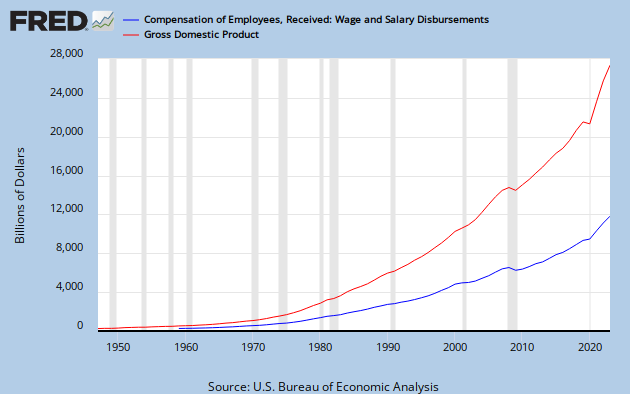
Wages and Salaries as a Portion of Gross Domestic Product
So I took the predictable flack from my “liberal” friends on Facebook after my recent comments on the “occupy Wall Street” business. There has also been much discussion of the protests elsewhere on the Internet. Eventually, these discussions turn toward uncomfortable things, such as facts and data.

An article cited made much out of the fact that the portion of U.S. gross domestic product (GDP) comprised of wages and salaries has shrunk quite dramatically over the last 50 years. While this apparent disparity isn’t necessarily a cause for concern, the article’s evocative graphic led me back to its source, the Federal Reserve Bank of St. Louis. There, I examined the data for myself and built some of my own graphs.

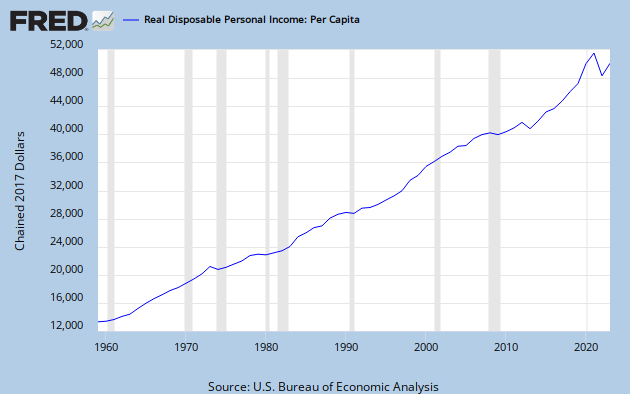
The Federal Reserve data yielded two interesting and somewhat unexpected facts. First, the sharp decline in income (adjusted for inflation) beginning in A.D. 2008 is one of historic proportions. That alone can explain the unprecedented anguish so many people are feeling. They are suffering, or at least they’ve received quite a shock after decades of relative prosperity. It also explains why “occupy Wall Street” took me personally by surprise, as I will explain shortly.…

Real Personal Income
Second, the overall growth in real income was equally unexpected. I had long subscribed to the “liberal” economic theory that real wages had been generally flat or even declining for several decades, driving the proliferation of the two-income household. Now, if the data are to be believed, that notion must be largely false. Yes, we can surely parse the numbers to show how certain segments have not benefited, but that would turn us toward other uncomfortable things, such as personal choice and responsibility.…

However, my own observations have now been confirmed, repairing a troubling logical contradiction. Since the late 1980s, I have watched a dramatic increase in personal wealth among the general population. Since that increase only rarely applied to me, I explained it away as a personal sampling error. Nevertheless, the people around me in a variety of income brackets seemed to have plenty of food, personal electronics, and expensive telecommunication contracts. Indeed, prices in these sectors were either fairly flat or even declining in some cases.

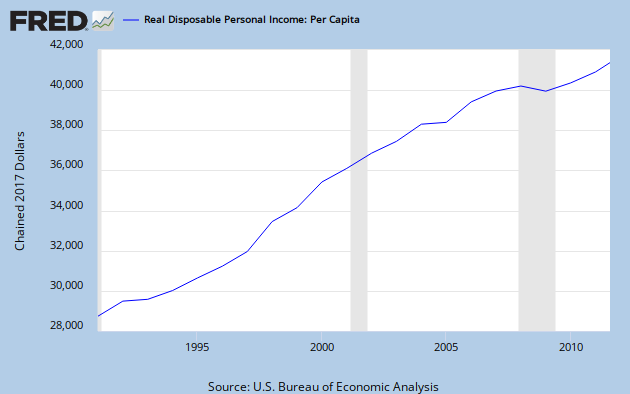
Real Income, 1991–2010
I’ve been a formal member of the workforce for 20 years now. As the graph above shows, change in real income was entirely positive during this period … until the financial crisis. My personal experience was very different. Though my working life has seen only three official recessions, my real income has been recessionary in nine of those 20 years. In other words, coping with declining wages has become normal for me.

The time when I felt the richest came shortly after I finished college and before my wife and I bought our house. Working full time, our disposable income increased rapidly but was still moderate. This allowed us to pay off our vehicles and student loans on time or early, so we were effectively debt free until buying our house.

M. D. Van Norman’s Real Disposable Income
That brief window of perceived prosperity came to an end when we became homeowners. In fact, the opening phase of my next personal recession was part of what enabled us to buy into an affordable housing program. Thereafter, my income continued to decline in real terms for six out of eight years. When it arrived, the great recession was simply treated as more of the same in my household.

Without digressing into those other uncomfortable matters, the moral of this post is that the financial crisis has had a profound effect on real income, much more so than I had thought. (Consider me properly chagrined.) However, the data also show the heretofore dramatic and largely sustained growth of that income. This latter fact should not be forgotten as we find our way out of the current crisis.

Tuesday, October 11, 2011

Occupying Wall Street

As I’ve said before, emotions run high in hard times, and people look for someone (usually someone other than themselves) to blame for their financial woes. That observation has been starkly illustrated in the last few weeks as thousands of mostly young people have rallied to protest flaws in the American economic system. This so-called occupy Wall Street movement began in New York but has spread to other cities.

Actually, my description above is a charitable one. Most of the protesters don’t fully understand what they are protesting. Instead of challenging they very real problems within our economic policy and regulatory structure, they are lashing out at big corporations, free markets, and capitalism in general—and griping about having to repay their student loans.

The more strident critics of the “occupy” movement are quick to point out the apparent hypocrisies and contradictions among the protesters. The protesters, they note, have arrived wearing designer clothes, bearing the latest smartphones, and enjoying many other accoutrements provided by the very corporations that they’ve come to decry. However, such criticism is as misdirected as the protests themselves, even if the observation is an extremely important one for a different reason … which I will explore shortly.

Predictably, the “occupy” movement has been met with approbation from the leadership of the Democratic Party and generally favorable reporting by the mainstream news media. In his panegyric for CNN, Douglas Rushkoff writes that the protesters “are pointing the way toward something entirely different than the zero-sum game of artificial scarcity favoring top-down investors.…” While something different may be on the horizon, Mr. Rushkoff displays some of the same economic ignorance shared by the protesters he admires.

Before I explain why they are misdirecting their rage, I must confess my sympathy for the “occupiers.” I understand their desires and frustrations. It is perfectly natural to want more for oneself and to envy those who appear to already have it. Channeling those feelings onto productive courses is the challenge that we all face.

Now, here is where they’ve gone wrong. Economics is not a zero-sum game. In fact, capitalism itself is predicated on an increasing-sum paradigm. Therefore, investors aren’t trying to take wealth from others via any sort of zero-sum chicanery. They are instead risking some of their existing wealth to build even more for themselves and by extension for society at large. The evidence of this and for capitalism’s unmitigated success is so ubiquitous that it often escapes notice. Capital investments and market forces have created and distributed so much wealth in a few short centuries that it boggles the mind. Human expectations are only just now catching up with this economic accelerando.

So the wealthiest people who have ever lived are presently complaining about the very economic engines that have delivered their wealth. Yes, if you have fine clothes on your back, magical electronics at your fingertips, and thousands of calories easily within your grasp, you are rich in absolute terms. Some of us have more than others, but we are all rich beyond almost any previous imagination.

And that brings me to why so many people are so angry. Our imaginations and expectations can expand. Revolutions may be triggered when expectations rise more quickly than they can be met. That is clearly the environment we see today, even if many of the heightened expectations are still unwarranted … still belonging to a future that we can’t quite touch.

Nevertheless, a new economic revolution may be on the horizon. Unfortunately, revolutions are always an uncertain business, prone to failure and fraught with potential danger. If there will be change, we must identify the right targets for reform, but that is not what I see happening within the “occupy” movement. If this economic anguish remains misdirected, it risks being co-opted by the very forces that have always sought to maintain that anguish for political gain.

I don’t know what shape the new economic model for a “post-industrial” America will take, but I do know that the best course into the future won’t be the quickest or the easiest one. Let’s begin with an inventory of our enemies and allies on the journey forward. Capital investments and free markets are not our enemies. They are our tools for building and distributing wealth. (We just have to learn to use them correctly.) Our only real enemies are those who would abuse economics for political gain and those who would abuse politics for financial gain. They aren’t that hard to identify.

Meanwhile, here is the best way to occupy Wall Street.

Investing has never been easier.
If you have no stake in the system, then you have no right to change it. Fortunately, in a free market, you can buy yourself a stake. Your dollars will often speak louder than your votes or your misdirected rage.