Showing posts with label U.S. Supreme Court. Show all posts

Thursday, June 23, 2022

The Civil Right to Bear Arms

Justice Clarence Thomas—undefeated American hero.

Yes, you have the natural right to bear arms for self-defense and other lawful purposes, and in the United States of America, that right has finally been confirmed as a civil right.

It has taken a long, strange journey to get to this point. Never mind that the first battles of the American Revolutionary War were sparked by an attempt to seize American arms. Never mind that the U.S. Constitution was explicitly amended to protect the right to keep and bear arms. Never mind that the U.S. Supreme Court ruled in Dred Scott v. Sandford that if black slaves were recognized as free citizens, they would have the right “to keep and carry arms wherever they went.” Never mind that the racist, slaving traitors who provoked the worst war in American history didn’t hang—but that’s a battle for another day.

In less ancient history, it’s been 14 years since the U.S. Supreme Court finally, reluctantly confirmed that the Second Amendment really did recognize an individual right to keep and bear arms—to own and carry weapons for self-defense and other lawful purposes in other words. Unfortunately, due to a quirk of American jurisprudential history, that fact still had to be incorporated among the several states. Never mind that the U.S. Constitution is still “the supreme Law of the Land.”

Nordyke v. King, an unlikely case about gun shows out of California, suddenly took center stage. For a moment it looked like the litigation would quickly establish incorporation for the Second Amendment right. Hopeful, naïve civil libertarians predicted that the citizens of California and similarly benighted states would win their rights within 18 months—but instead we got an education in en banc review. Instead we saw the lower courts in prohibitionist jurisdictions—where the unrepentant traitors’ bigoted poison had so long festered among otherwise liberal minds—revolt against the plain language of the Supreme Court.

What was supposed to be a quick victory for individual liberties became a long, exhausting and divisive slog through the courts—and even through the White House. Once we did eventually win incorporation in McDonald v. Chicago, constitutionalists, right-to-arms advocates, and civil libertarians lost again and again when we tried to make something meaningful out of the Second Amendment. Coalitions rose and fell, friendships were made and destroyed, and the Supreme Court seemed content to allow the lower courts to ignore its guidance and continue to treat the right to bear arms as “a second-class right.” That is … until today.

In the majority opinion for New York State Rifle & Pistol Association v. Bruen, Justice Clarence Thomas wrote, “We know of no other constitutional right that an individual may exercise only after demonstrating to government officers some special need.… New York’s proper-cause requirement violates the Fourteenth Amendment in that it prevents law-abiding citizens with ordinary self-defense needs from exercising their right to keep and bear arms.” Moreover, the ruling insists upon textual and historical analysis alone when determining the constitutionality of any laws regulating the right to arms, negating the “intermediate” approach used by the lower courts so often during the last 14 years.

You have the right to carry firearms for lawful purposes … but under Justice Thomas’s reasoning, licensing regimes and other categorical prohibitions should all fall. Of course, time will tell, and the price to get this far has been steep.

However, for those of you in the six states most affected by today’s ruling, if you worry about “blood in the streets” when law-abiding gun owners are allowed to carry their weapons, you shouldn’t. That fear has always been based on propaganda. After the ruling has been implemented, you won’t notice any difference. In fact, after a few months, you will probably forget all about this … or maybe you will decide to exercise the right yourself.

Monday, May 5, 2014

Drake Declined

"No justice, no peace."

The wave has broken far from shore. Today, the U.S. Supreme Court declined to review Drake v. Jerejian, continuing its avoidance of right-to-carry cases. This tacit choice for potential violence is still astonishing even after similar dereliction in the matters of Kachalsky and Woollard, but there is yet hope.

The floodwaters of unrest may inundate the northeast, but if the Peruta decision stands in California, the potential damage may be minimized. The abuses are so longstanding and the geographies so small that the high court’s ersatz federalism might suffice to release enough pressure in the region. Once the people of the West are freed, only somewhat less than 20 percent of Americans will remain under fully prohibitionist regimes.

Tuesday, October 15, 2013

Avoiding the Question

It's time to raise the black flag of defiance.
The U.S. Supreme Court made an unconscionable mistake today. In declining to review the matter of Woollard v. Gallagher, which questioned the constitutionality of requiring “good and substantial” cause for the issuance of a permit to carry a handgun, the high court has signaled with dread certainty that it will do nothing to protect the civil right to bear arms for the nearly 100 million Americans who reside in prohibitionist states. Moreover, this shirking of responsibility will doom the nation at large to suffer the consequences of decades of frustration that must soon be released.

Though several right-to-carry challenges still remain active in the federal courts, we have no reason to expect different outcomes for these cases. Those subjects of California, New York, New Jersey, Massachusetts, Maryland, and the other gun-control bastions are now left with only two choices: flight or defiance.

Wednesday, December 19, 2012

Reasonable Gun Control

Checked, registered, licensed, and trained. How much more reasonable can gun control be?
 
“I support the Second Amendment, but I think we should have reasonable gun controls.” This is a line frequently heard from politicians and certain special-interest groups. While it’s often disingenuous—since what the most vociferous gun-control proponents really desire is total prohibition, presumably in the noble but misguided hope of creating a non-violent society—I will nevertheless take the statement on its face for the sake of discussing reasonable gun-control measures.1

As the U.S. Supreme Court has repeatedly held, all civil rights, no matter how fundamental, are subject to some degree of regulation in a society structured on ordered liberty. The Second Amendment right to keep and bear arms is no different. Furthermore, in D.C. v. Heller, while affirming the individual right to arms for self-defense and other lawful purposes, the high court opined that many longstanding gun-control regulations are presumptively lawful.

This brings us to the fact that most of the reasonable gun controls commonly demanded have already been in place for many years or even decades. However, not all of these regulations have been fully or properly implemented. I will examine each of these reasonable proposals below and offer suggestions for more effective improvement. Some of these gun-control schemes are more reasonable than others and will probably pass constitutional muster in the face of ongoing legal challenges, but some will fail this test and are likely to be stricken.

Background Checks


No one wants guns in the hands of violent criminals or the dangerously insane, so background checks have been federally indicated pursuant to all commercial firearms sales since the Gun Control Act of 1968 and much earlier in many states. Though their actual effectiveness is questionable due to the durable nature of firearms2 and the propensity of criminals to acquire their guns via illegal means, the process has become relatively painless with the advent of the National Instant Check System (NICS) in the 1990s, and most transactions can now be cleared or denied within a matter of minutes. Since nearly instant background checks don’t unduly burden the right to arms, they will probably be ruled constitutional if challenged.3

Nevertheless, the system does have its flaws. First, NICS depends on data gathered from a number of sources. When the various agencies responsible for collecting this information fail to input disqualifying criteria, the system may still clear someone who should have been prohibited. Second, due to the high volume of false positives, law-enforcement agencies are unable to investigate denials. While most denials are overturned on appeal, a few are undoubtedly the result of legitimately prohibited persons,4 who may then proceed to obtain guns illegally. Both problems can be mitigated with greater attention to accurate and thorough data collection and by improved database integration.

Furthermore, despite the largely successful implementation of NICS, various provisions of the Gun Control Act keep gun sales mired in mid-20th century practices, particularly when interstate transactions are involved. By law, a Federal Firearms License (FFL) is required to deal in firearms, but licensees are restricted to face-to-face transactions with residents of their own states, except when dealing with other licensees. This can actually compromise the security of an interstate transfer, as the firearm must pass through many more hands on its way to the legal buyer, increasing the likelihood that it may be lost or stolen along the way.

There are two possible and relatively easy solutions to this problem, though both would require that the law be amended. First, leveraging the NICS service, outdated residency requirements could be eliminated, allowing any cleared customer to take delivery of a firearm without being forced to first have it shipped to a licensed dealer in the customer’s home state. Second, an existing category of FFL could simply be expanded to include a wider variety of firearms, affording the licensed collector more convenience while exposing him and the community at large to less risk.

These reforms would also have the added benefit of further discouraging undocumented and potentially unlawful private sales, which I will discuss in more detail below.

Registration


We’ve had de facto gun registration at the federal level (as a result of the record-keeping requirements for FFL holders) and de jure registration in several states for many, many years. Though registration is of dubious utility to law enforcement, it has also done little harm to law-abiding gun owners, despite dire predictions from some quarters within the right-to-arms camp. Implementing a standardized federal registration system would work very well in conjunction with the modernized interstate-transfer procedures described above.

That said, there is some evidence from the courts that registration may be deemed unconstitutional. It certainly contradicts the Fourth Amendment right to privacy. Arguably, however, the militia clause of the Second Amendment suggests that the government may have a constitutional interest in understanding the disposition of arms suitable for militia service—and I will discuss which firearms should be considered militia weapons in detail below.

Licensing


Beyond the FFL system described above, there has long been a call to license gun owners. We license drivers after all … or so the argument usually goes. In fact, though, licensing regimes are now present in all states but Illinois—a problem being addressed in the courts right now. Unfortunately, several of the most populous states (including California and New York) still continue to discourage their citizens from becoming licensed, despite having had licensing systems in place for many decades.

Indeed, licensing reform is currently the top priority within the right-to-arms movement, where it is viewed as the gun-control measure offering the single most immediate benefit to public safety. To that end, multiple legal challenges to unconstitutional licensing practices are working their way through the federal courts and will likely reach the Supreme Court within the next two years. The high court is widely expected to rule that while states may regulate when and where their citizens may carry guns for self-defense and other lawful purposes, there must also be a legal mechanism for them to do so that is administered equitably and that doesn’t unduly burden the core right.

I have reported on liberalized or shall-issue licensing before. Whenever and wherever such licensing reforms have been adopted legislatively, there have been exaggerated claims by opponents that gun violence would explode as licensees instigated shootouts for all manner of trivial reasons. Of course, no such thing ever happens. Instead, licensees have proven to be exceptionally law-abiding, and the data suggest that right-to-carry laws contribute to an at least slight decrease in violent crime.

This decrease is due mostly to the deterrent effect of an armed populace. Even though only a tiny fraction of the eligible citizens choose to obtain licenses, would-be attackers are still dissuaded and seek out softer targets. Over time, this effect should become more pronounced as a larger percentage of the population becomes licensed and, hopefully, as other criminal-justice reforms are implemented.

However, I won’t argue that armed citizens are a perfect antidote for episodes of mass murder.5 Both are statistically rare, so the likelihood that a licensee will be immediately present when one of these very unusual events erupts is exceedingly small. While the chances that an armed citizen will simply be nearby are significantly higher, licensees are not police officers and are trained to avoid confrontation whenever possible. In any case, the event wouldn’t be recognizable any longer, since the headline would read: “Gunman opens fire in crowded shopping center. Dozens injured.”

Safety Training


Safety and competency training will always be valuable where firearms are concerned. In fact, voluntary safety programs formalized in the 1950s and championed by the National Rifle Association are probably responsible for reducing the rate of fatal firearms accidents to statistical insignificance. Nevertheless, states that don’t include any training as part of their licensing requirements still haven’t seen an increase in accidental shootings, which suggests that stringent training demands would provide little additional benefit to public safety.

That said, any potential training requirements that weren’t unduly burdensome would probably be deemed constitutional. Here again, the Second Amendment provides for a well-regulated militia, and in its 18th-century context, well regulated was understood to mean well trained. To this end, basic firearms safety could reasonably be included in school curricula, possibly helping to reduce accidental shootings even further.

Waiting Periods


Waiting periods have come and gone over the years, but they were sold politically to accomplish two goals. First, waiting periods allowed time to conduct the mandatory background checks, though NICS has essentially obviated this need. Second, they provided a cooling-off period for any gun buyer who might be acting on some temporary murderous impulse, though I’m aware of no correlation between waiting periods and reduced homicides.

In short, waiting periods have probably outlived any utility they may have had. Nevertheless, in California and other states where they remain, there is speculation that at least initial waiting periods for first-time gun buyers would survive constitutional challenge. If this proves to be the case, though, the state may be left in the position to delay access to firearms to those who may legitimately and suddenly develop an immediate need for effective self-defense.

Unfortunately, I see no remedy for this problem, if cooling-off periods are allowed to stand. It may simply be a matter of personal responsibility for those living within an imperfect system. It’s probably too late to buy the fire extinguisher once the fire has already started.

Private Sales


This is the so-called gun-show loophole. While gun shows enjoy no special exemptions, under federal law and in many of the several states, private sales are largely unregulated. Private parties are free to dispose of their own property as they see fit, so long as they aren’t knowingly transferring firearms to prohibited persons or dealing without a license.

For those less familiar with gun laws, you may find the dinner-party loophole somewhat easier to understand. This is the gap in health-and-safety laws that allows you to serve food and drink to your own family or to host a dinner party for friends and associates without having to obtain FDA approval or a conditional-use permit from your county of residence. Closing this loophole would require you to obtain the services of a licensed caterer before dining at home.

While there is much talk about requiring all private firearms transfers to be conducted through the agency of licensed dealers, as they currently are for the most part in California, it’s unclear whether such restrictions would be deemed constitutional. In addition to the Second Amendment, controls on private property also implicate the Fourth, Fifth, and Ninth Amendments. On top of this, such regulations are very difficult to enforce, effectively guaranteeing a low rate of compliance.

A better approach would be to encourage voluntary participation in the national background-check system. Providing private sellers with access to NICS would be well received by the vast majority of gun owners, who are generally eager to follow the law and who would appreciate the extra peace of mind while still avoiding the gross inconvenience of conducting private sales through licensed dealers. While this certainly wouldn’t eliminate all undocumented transactions, it would minimize them to a large extent, allowing law-enforcement resources focused on the illegal arms trade to be targeted more efficiently.

“Dangerous and Unusual Weapons”


In Heller, the Supreme Court explicitly ruled that weapons “in common use” by the people are protected by the Second Amendment, implying in its historical analysis that “dangerous and unusual weapons” could be subject to more stringent controls. However, these terms were left somewhat vague. The specific weapon “in common use” in this case was a personally owned handgun, but which weapons are “dangerous and usual”? And how does this decision square with the only previous Second Amendment ruling, U.S. v. Miller?

In Miller, the high court held that weapons suited for militia service were constitutionally protected. While this ruling may be regarded as partly erroneous due to the incomplete briefing process before the court, at present time, the weapon best suited for militia duty would be a select-fire assault rifle chambered for the 5.56×45mm NATO cartridge—or at the very least a semi-automatic analog thereof. However, select-fire weapons, other fully automatic firearms, and various “destructive devices” have been tightly controlled since the National Firearms Act of 1934 and essentially banned from production for the civilian market since 1986.

If the prohibitions on “dangerous and unusual” military weapons are constitutional, then that leaves us with semi-automatic versions of military rifles as the de facto protected militia weapons “in common use” by the people. However, despite their involvement in only a fraction of gun-related homicides, these are the very same “assault weapons” that so many gun-control proponents would like to see banned.

Now, as I’ve written before, so-called assault weapons are fictitious. The term was used to frighten the uneducated public into support for the federal ban that expired in 2004. A semi-automatic rifle is a semi-automatic rifle, regardless of whichever secondary features it may have—and like millions of other Americans, I own one myself. My modern Kel-Tec SU-16 rifle with its traditionally shaped stock is really no different than a 50-year-old Colt AR-15 with a pistol-grip stock. Both are chambered for the same intermediate 5.56mm cartridge.6 Both can accept the same five-, 10-, 20-, 30-, 60-, or even 100-round magazines. And both can fire only one shot for each pull of the trigger.

Therefore, per Heller, semi-automatic rifles are “in common use” and thus constitutionally protected for lawful purposes. They are also the only readily available militia weapons protected per Miller. Unless the prohibitions on more appropriate military-grade weapons are to be relaxed, any bans on semi-automatic “assault weapons” are both pointless and very likely unconstitutional.

Gun-Free Zones


Gun-free zones are a dangerous fiction and should be eliminated immediately. Vague, poorly defined zones have been ruled unconstitutional once before and doubtlessly will be again when an appropriate challenge arises. In the meantime, as we’ve learned tragically and repeatedly, the only guns these zones are free from are those held by law-abiding citizens.

Specific zones are more legally tenable, but to effectively implement truly gun-free zones would require secure perimeters, controlled access points with thorough searches of all incoming traffic, and ubiquitous surveillance.7 In other words, we would have to turn these “sensitive places” into prison camps. This would be both impractical in economic terms and antithetical to a free and open society.

Let’s reserve the prison-camp mentality for places where we really have no other choice … such as in actual prisons.

The foregoing gun-control proposals represent what reasonably can and cannot be achieved. Properly implemented, they can provide us with a constitutional and functional right to arms while still allowing both practical and symbolic legal tools for reducing violent crime. Most are already in place and need only minor adjustments to be made more effective.

This goal is politically possible for those who honestly wish to enhance public safety while also protecting our civil rights. The vast majority of gun owners already support these reasonable measures, and none of us expect to win a completely unfettered Second Amendment. What we do not appreciate is continually being blamed for the wrongdoing of the minority of willfully evil and dangerously insane people in this world, and we will certainly no longer tolerate being punished for their crimes.


  1. The intellectually honest supporter of reasonable gun control will ultimately find himself in the right-to-arms camp. I should know, because I was that person. While my views have evolved toward libertarianism and away from the utilitarianism implicit in the unreserved support for gun control, that doesn’t change the fact that we will be living with some degree of utilitarian regulation until long after the subject has lapsed into irrelevance.

  2. A well-maintained firearm will remain functional for hundreds if not thousands of years, and there are at least 800 million already in circulation worldwide. We will never run out of guns. This is one of many reasons why outright prohibition is an unacceptable proposition.

  3. Of course, if background checks are acceptable for the exercise of a fundamental civil right, then arguably they should be applied to other less protected areas as well, such as voting rights, driving automobiles, or the receipt of public benefits.

  4. I would argue that there should also be a way for prohibited persons to eventually restore their civil rights. Otherwise, the utilitarian argument dictates that anyone too dangerous to be trusted with a firearm is too dangerous not to be incarcerated.

  5. It certainly wouldn’t hurt to allow licensees to go armed in otherwise unsecured “sensitive places.” Existing laws vary widely in this respect.

  6. Military assault rifles and their semi-automatic civilian analogs are chambered for intermediate cartridges, more potent than low-powered handgun cartridges but less powerful than the high-powered rifle cartridges used for hunting and long-range precision shooting.

  7. Even the strictly enforced gun-free zone only relocates the problem. Instead of a bunch of unarmed victims congregated inside the zone, we would have a bunch of unarmed victims queued up outside the zone waiting to be screened for entry. Either way, the would-be mass killer is presented with a target-rich environment.

Monday, June 28, 2010

Beyond Chicago and Incorporation

And the Second Amendment has come back to California … again … and to the rest of the several states as well.

Today’s U.S. Supreme Court ruling in McDonald v. Chicago wasn’t the historic victory for civil rights that it could have and perhaps should have been, but it was a victory nonetheless. The court failed to breathe new life into the 14th Amendment’s intended protection for the “privileges or immunities” of American citizenship, but it still found that the Second Amendment applied to state and local governments, restoring the right to arms to its proper place in the pantheon of American civil rights. That is cause enough to celebrate for many reasons.

So what happens next?

Even after Chicago’s handgun ban is dismantled, many details about the nature and scope of the right to arms will still have to be defined. Many gun-control laws will be challenged. Some will pass constitutional muster, and some will not.

Legal challenges that have been on hold here in California can now proceed. The state’s concealed-carry licensing system and certified-handgun roster are clearly discriminatory and violate equal protection under the law. These are the low-hanging fruit. The optimists at the Calguns Foundation expect these to fall within two years.

Meanwhile, the usual batch of gun-control legislation has been moving forward, despite the fact that some form of incorporation has been widely expected since the ruling in D.C. v. Heller two years ago. California legislators and officials are either too ignorant or too disingenuous to avoid the oncoming train of constitutional law.

Elsewhere, some good progress has been made during the last year. Iowa joined the ranks of right-to-carry states, while Arizona became the third state to allow concealed carry without a license or permit. Federal regulations prohibiting firearms in national parks have also been lifted.

Why is this all so damned important? That I will explain in a future post.

Wednesday, March 3, 2010

Business as Usual at the Supreme Court?

So oral arguments in McDonald v. Chicago were made before the U.S. Supreme Court yesterday. While the court is widely expected to rule that the Second Amendment does apply to state and local governments, attorney Alan Gura arguing for the plaintiff received a somewhat hostile reception as he made the case for reviving the original intent of the 14th Amendment’s “privileges or immunities” clause, which had been mostly nullified by a previous ruling in A.D. 1873.

This seemed odd, since the High Court’s dicta in D.C. v. Heller appeared to invite a new look at this very issue. The more cynical observers were quick to suggest that the whole thing might have been a setup. Perhaps, they argued, the “conservative” members of the court wanted the issue before them specifically to kill “privileges or immunities” for another century or two.

Why? Because a fully realized 14th Amendment would revolutionize the civil-rights movement. That the Bill of Rights applies in all its glory to the states as well as to the federal government could no longer be denied. Minority groups still fighting for their share of American liberty would also have an easier time of it.

On the other hand, one well-educated correspondent of mine pointed out that the exchange resembled an academic thesis defense. The faculty may savage the student, but if his arguments are sound, his diploma will be secured. Viewed from this perspective, the proceedings can look much more promising for a reading of the 14th Amendment that is finally right and proper.

In any case, it looked like business as usual at the Supreme Court, but we probably won’t know for sure until June.

Wednesday, September 30, 2009

Supreme Court to Hear Incorporation Case

The U.S. Supreme Court will hear McDonald v. Chicago to decide if the Second Amendment is incorporated against the states via the 14th Amendment. The case challenges Chicago’s ban on handguns, which is very similar to the District of Columbia’s ban that was struck down as unconstitutional last year. This case also bears watching for its approach to incorporation, which could finally put an end to this long bit of legalistic fiction.

Meanwhile, all pending right-to-arms litigation in California is on hold.

Tuesday, July 7, 2009

California Asks for Nationwide Incorporation of the Second Amendment

On July 6th, Attorney General Edmund G. Brown submitted an amicus brief to the U.S. Supreme Court on two pending Second Amendment incorporation appeals out of Chicago. Citing the protection of Constitutional rights in California, AG Brown encouraged the high court to hear these cases and to affirm the applicability of the Second Amendment to the states. He also asked the court for guidance on what kinds of firearms regulations are permissible.

The momentum for reform is clearly mounting now. The Supreme Court will doubtlessly rule in favor of nationwide incorporation, which will make sweeping advances for the legal right to arms almost inevitable. Furthermore, AG Brown’s brief also focused attention on California’s particular plight, which is shared by a handful of other states (such as Illinois and New York). Together, we suffer under a tangled, ineffective mass of gun-control laws that are becoming ever more clearly unconstitutional.

It seems that the question I asked just two months ago has been answered. A quiet but well-placed ally has indeed found the political cover needed to move toward a more reasonable interpretation of the right to arms in California.

Wednesday, April 22, 2009

A Small Victory for Privacy Rights

Amid all the other excitement this week, I almost overlooked another civil-rights victory. In Arizona v. Gant, the U.S. Supreme Court ruled that police need a warrant to search the vehicle of someone they have arrested, if that person poses no threat to officers. While this decision doesn’t moot searches for “officer safety” permitted under Terry v. Ohio, it is a small step forward for Fourth Amendment protection of privacy rights.

Watch where you park.

Saturday, April 11, 2009

“If I Only Had a Gun”

I suspected that I would regret it, but I did it anyway. I watched Diane Sawyer’s report, “If I Only Had a Gun,” on ABC’s 20/20 last night. I was expecting bias that would lean away from gun ownership and the right to arms, but what I saw was an hour of shamefully unadulterated propaganda.

I’m not naive when it comes to journalism. I’ve had my share of experience being misquoted, plagiarized, and editorially marginalized, but this was mainstream media bias in rare form. There were omissions, lies, and even fabricated evidence.

The broadcast sought to make four main points. Firearms are ineffective weapons for self-defense. Children are in grave danger of being killed by improperly stored firearms. “Gun violence” plagues a small town in Florida. Weapons can be obtained too easily through the “gun-show loophole.”

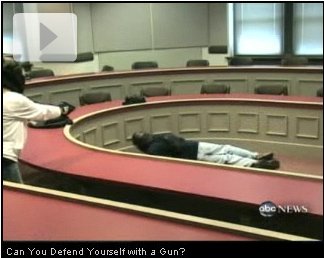
Can You Defend Yourself with a Gun?

The first segment dealt with carrying handguns for self-defense. To demonstrate that armed civilians are doomed to failure, ABC contrived a scenario designed to almost guarantee such failure. Posing as a deranged gunman, a well-trained police firearms instructor bursts into a small classroom and begins shooting simulated bullets. A barely trained college student wearing an awkwardly long shirt, bulky gloves, and cumbersome headgear is expected to engage this threat with his own mock handgun. Naturally, none of ABC’s handpicked subjects were able to make any quickly incapacitating shots. However, though this fact was minimized, one young woman did manage to deliver a probably fatal wound to the assailant’s femoral artery, which would have mitigated the casualties from his rampage as he rapidly bled to death on the classroom floor.

One hapless test subject scores a fatal hit.

Indeed, if someone walks up and immediately begins shooting you at close range, your chance to successfully defend yourself is already over, regardless of how well you may be armed. This applies even to well-trained police officers, who are far less common than ABC implied. Throughout the segment, video of intensive tactical training suggested that the average cop is a firearms expert. Unfortunately, standard police and even military firearms training is actually very basic. My own marksmanship skills are minimal, but even I have outperformed federal law-enforcement officers at the shooting range.

However, any honest right-to-arms advocate will tell you that a firearm is not a magic talisman that will guarantee your survival in a violent confrontation. Having a gun merely gives you a fighting chance, but that chance can be very small. I know that I would rather risk injury in defense of my loved ones than do nothing only to see them brutally murdered.

Extrapolating from this worst-case scenario that carrying a handgun can never help you in a violent encounter would be unwise at best, but this is exactly what ABC did. As further evidence, Diane Sawyer herself stepped up to a police simulator and failed to draw her sidearm quickly enough. Of course, that was a self-fulfilling prophecy, but don’t let her cover you in a potential firefight.

Diane Sawyer plays with guns.

In the end, ABC and Diane Sawyer were making a case that no one should be armed, not even the police. Of course, total disarmament is the ultimate goal of the gun-control movement. Despite their wishful thinking for a non-violent society, if the prohibitionists ever succeed, they would only turn the whole world back into Pahokee, Florida, as we will see in a moment.

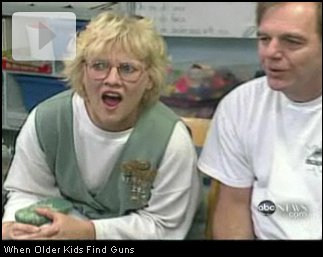
When Older Kids Find Guns

The second segment explored the attraction guns hold for both younger and older kids. In another poorly constructed experiment, children were shown handling and playing with firearms placed where the kids would find them. Why this should surprise anyone is unclear.

A parent is shocked that her child would play with something.

Children are naturally curious. When adults try to hide something from them, they become even more eager to explore. The lure of forbidden fruit is a well-known phenomenon.

As usual, the answer is proper education. In the show, only the young man with gun-safety training resisted the temptation to improperly handle a found gun. The others all demonstrated their profound ignorance, though this occasionally had to be encouraged by ABC collaborators. Education saves lives.

Fortunately, accidental shooting deaths are actually very rare.

Damon Weaver’s Plea to Obama

Pahokee is a town of 6,000 souls, few jobs, and an “infinity of guns.” When darkness falls, the violence begins. Gangs rule this place, and by the light of day, the law-abiding residents are too frightened to help the police. Young, would-be journalist Damon Weaver asks what President Barack H. Obama will do to help his town.

Should a boy determine your civil rights?

Criminal gangs are the problem here. Criminals are already prohibited from having firearms, but one gang member boasts that he can get an illegal handgun for $60. When I legally purchased a police-surplus pistol for $350, I thought that was a smoking-hot deal.

Violent gangs are a problem older than human civilization. In fact, they are the problem that led us to form governments and states. We can no longer apply the historical military solutions, but until we put an end to the institutionalized poverty that encourages modern gangs and to the black markets that finance them, the problem will persist.

Firearms prohibitionists would unintentionally—or so I assume—return the whole world to the conditions of Pahokee, Florida. When the good people are disarmed, it will once again be the ruthless, violent gangs that dictate social policy. Violence as a means of conflict resolution is most effectively neutralized only when all sides are equally equipped to do violence.

I will answer little Damon’s question with my usual cynicism. President Obama will do nothing to help Pahokee. Doing so would be to reject the institutionalized poverty and paternalistic racism that is his party’s source of political power.

10 Guns in One Hour

The next myth that ABC promoted was the “gun-show loophole.” I have already written an article on this topic, but let me reiterate that there is no loophole. All federal, state, and local laws continue to apply at gun shows.

They worry about your private-property rights.

To illustrate their point, ABC gave $5,000 to the grieving brother of a Virginia Tech victim and sent him to a gun show in Richmond. Within an hour, the young man was able to buy 10 firearms (mostly old rifles and shotguns) from private parties at the show. He found some pretty good deals but nothing approaching the $60 stolen handguns in Pahokee.

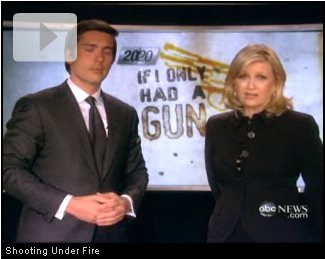
Shooting Under Fire

The final segment wrapped up the rigged experiment that opened the broadcast. Diane Sawyer closed with this blatantly false statement: “… if you’re wondering where’re all the studies about the effectiveness of guns used by ordinary Americans for self-defense, well keep searching. We could not find one reliable study.…” Apparently, Ms. Sawyer and her “research” staff have never heard of libraries or even Google Scholar, where the ongoing academic discussion on the subject can be uncovered in less than five seconds … or maybe the facts didn’t support their predetermined conclusions.

Diane Sawyer lies on national television.

About the only thing that ABC and Diane Sawyer got right in this report is the fact that you are unlikely to be shot and even less likely to be shot fatally. A gunfight is one of the last places anyone should want to be, but having a gun does improve your odds of survival, according to federal crime data. That fact was nowhere to be seen in last night’s broadcast.

Firearms aren’t for everyone, but we have an inalienable right to arms. The U.S. Supreme Court has now recognized that fact. Nevertheless, the prohibitionists in the mainstream media clearly aren’t ready to abandon their propaganda campaign.

Thursday, June 26, 2008

Supreme Court Rules on the Right to Arms

At long last, the U.S. Supreme Court has ruled that the Second Amendment to the Constitution protects the individual right to keep and bear arms for self-defense and other lawful purposes, striking down the District of Columbia’s 30-year-old ban on private handguns. Unfortunately, the court’s decision in D.C. v. Heller was not the sweeping, revolutionary opinion that might have spared Americans from many more years of political theater and emotional litigation. Civil libertarians still face a long and torturous path to create a working freedom from the Constitutional right.

Indeed, the court was almost evenly split on the matter. In a disappointing display of intellectual dishonesty and contradictory reasoning, four justices dissented from the majority, favoring their personal opinions over nearly self-evident constitutional law. Tonight, however, the way is ever so much clearer, so I raise my glass in thanks to the five justices who finally ended 216 years of uncertainty.