Showing posts with label institutionalized poverty. Show all posts

Sunday, September 27, 2015

The Parable of the Ditch Digger

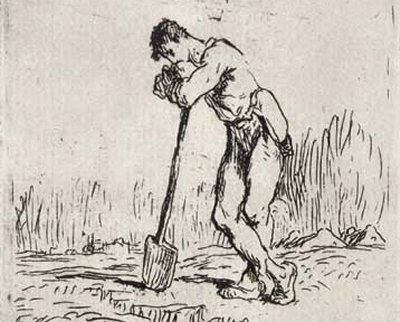
Homme appuyé sur sa Beche (Jean-François Millet, c. 1848)

Let us consider the plight of the lowly ditch digger, the stereotypical example of the unskilled laborer. He is barely literate and so bereft of other talents that he is probably unemployable in any other vocation—or at least that’s the way many of us treat him. What is to become of such a marginal worker in our modern globalized economy?

“We must help the poor ditch digger,” says the altruist. “Society should provide him with food, housing, and medical care, so he can live in good health and security. We can’t let the wretch starve to death on the street while others live in luxury and dine upon the finest fare! Everyone must sacrifice to save this poor soul from himself.”

“No, no!” replies the interventionist. “Instead, the government should pay him to dig ditches and fill them in again. The money he spends will stimulate economic activity. No new goods or services will be produced, since we’ll only be moving resources around, but everyone will be employed.”

“I have a better idea,” offers the capitalist. “I could employ several ditch diggers on my construction projects. Their labor would add real value to my investments! I would pay them small wages, but they would enjoy honest remuneration, the dignity of productive work, and the opportunity to learn new workplace skills and advance their careers. If my investments succeed, there will be more goods and services available, and everyone will grow a little bit wealthier, including the ditch diggers.”

“You can’t pay him small wages!” the altruist says in horror. “How would he support his wife and children on such a pittance?”

“The ditch digger needs a fair wage—a living wage,” the interventionist adds. “The government should mandate minimum wages that guarantee workers won’t live in poverty.”

“Frankly,” the capitalist responds, “his labor isn’t worth more than that. If higher wages were mandated, I would be better off dismissing the ditch diggers from my employ and acquiring mechanized entrenching equipment to enhance the productivity of my more skilled workers. The ditch diggers will be out of work, my projects will be a little less profitable, and we’ll all be little bit less well off than we might have been.”

“Have you no heart?” laments the altruist. “Will you let the poor ditch digger suffer and perish for your greed?”

“I certainly do have a heart!” retorts the capitalist. “When I can, I donate to charitable organizations that support the victims of disaster and indigence. You do the same, I’m sure.”

“Well …” the altruist hesitates. “I pay my taxes.”

“Indeed!” the interventionist says. “Contribution must be mandatory in order to maintain the public welfare in an equitable manner.”

“Don’t worry,” a politician slyly interjects. “I can fix everything. I’ll write laws setting a minimum wage for all workers and providing food stamps, housing vouchers, and free health insurance for the unemployable. Of course, we’ll have to levy higher taxes or borrow money to pay for all these benefits. Grateful for the public largesse, the people will reward me with their votes, and I will win re-election!”

“You do realize what will happen?” asks the capitalist. “Costs will rise throughout the market until the buying power of the higher wages has been reduced to their real value. Meanwhile, the ditch diggers and many other unskilled workers will be driven from the workforce. Some will never return, permanently relying on public benefits for their survival. In other words, your policies will actually perpetuate poverty!”

“So much the better!” enthuses the politician. “I can legislate for higher wages and increased public benefits again and again. I’ll have those ditch diggers voting for my party for the next 200 years.”

So what will become of the benighted ditch digger? Will he be allowed to contribute his value, however meager, to the economy at large and to share in the concomitant opportunity for advancement toward prosperity? Or will he be consigned to live in unemployment and relative poverty forever—or at least until other people’s money runs out?

Sunday, December 8, 2013

Time for a Basic Living Stipend?

Can we afford to guarantee an income for all citizens? (Photo: SPIRAL)

In her seminal science-fiction novel Beggars in Spain (William Morrow & Co., 1993), Nancy Kress describes a futuristic American welfare state wherein 80 percent of the population survives comfortably, if somewhat squalidly “on the Dole,” rather than engaging in productive employment. This largess is financed by patent royalties from an energy-production breakthrough, but the actual United States of the early 21st century A.D. is a fantastically wealthy country and already provides extensive public benefits to its poorest citizens. However, these benefits are delivered through hundreds of different programs that are administered under a variety of political conceits, making the American welfare system both inefficient and condescending.

According to the Cato Institute, federal, state, and local governments spent over $950 billion on welfare benefits in 2012. That’s over $20,000 per poor person or nearly twice the federal poverty threshold. Of course, a significant portion of these funds are lost to bureaucratic overhead. Therefore, as bleeding-heart libertarian Matt Zwolinski asks, wouldn’t it be better to put the money directly into the hands of poor people rather than passing it through layers of government administrators and social workers?

That’s where a basic living stipend comes into the picture. While fictional, Nancy Kress’s version of universal welfare is broadly similar to historical proposals such as the basic income guarantee or the negative income tax. Under such proposals, governments would provide all their citizens with a certain minimum income, either as an outright grant or as a variable tax credit, in order to keep them above the poverty threshold. In theory, minimum-income schemes would replace inefficient, paternalistic welfare states with streamlined transfer-payment systems, maximizing benefits to recipients and minimizing costs to taxpayers.

A “heartless libertarian communist” myself, I am generally skeptical of welfare schemes, both social and corporate, but before I indulge that skepticism here, I should note that, as Dr. Zwolinski points out, the idea of income guarantees also has origins and support in modern libertarian thought. He offers three reasonably compelling arguments in support of such proposals. These include the aforementioned efficiency improvements, approximate reparations for historical injustices, and necessary requirements for democratic legitimacy.

I find the last argument, advanced previously by none other than free-market economist Friedrich Hayek, to be the most morally compelling. Though I would advocate for the voluntary society, the fact remains—and may always remain—that all human beings live under the rule of coercive states. Since it is the political tendency of both left and right authoritarian regimes to institutionalize relative poverty, it becomes morally imperative for governments, in order to maintain their own legitimacy, to ensure that their citizens do not fall into absolute poverty.

Moving as that argument may be, I remain highly skeptical of income guarantees for two reasons. First, I doubt that they would reduce relative poverty at all. There would still be plenty of comparatively poor people, but they would all have food, clothing, housing, and entertainment. Their numbers would also seem likely to expand due to the free-rider problem, though this could be mitigated to some extent if the system were implemented correctly.

The second reason follows from the first and is significantly more disconcerting. If free riders or economic disincentives lead to an expansion of relative poverty, how much of an increase in income transfers (and concomitant decrease in productivity) can the general economy absorb before collapsing? Assuming that the threat of such a collapse is considerable, the risk will increase with the sensitivity of income guarantees to normal political processes. This latter concern is why Dr. Zwolinski rightly suggests that income guarantees should be enacted only at the constitutional level, though the controlling economic indices would no doubt still be subject to political manipulation.

Nevertheless, I’ve begun to think that it’s a risk worth taking. One reason that the byzantine welfare state is so pernicious is because it effectively conceals the diseased portions of the political organism, allowing otherwise good people to support programs that while ostensibly intended to help the poor actually perpetuate their relative poverty. Though income guarantees would probably do no better at reducing poverty, they would cast off the veil, exposing both the free riders, who would no longer have anything to hide, and bringing greater transparency to the political kinesthesis that institutionalizes poverty. Presumably, once these problems were open to ready observation, rational political actors would move to address them.

On a more optimistic note, public stipends should sweep away paternalistic welfare schemes by treating recipients as adults responsible for their own financial decisions. This would also be a step toward the moral courage required to accept individual failure as a natural and occasionally healthy part of human development. Furthermore, though this may mostly be Marxist wishful thinking, it is possible that even free riders might contribute some unexpected dividend to justify the productive members of society carrying their general slack. In fact, savvy free riders who were wise with their public stipends could eventually save enough money to channel into private investment, profiting for themselves while financing real economic growth. Finally, since guaranteed incomes would effectively remove low-end workers from the labor pool, competition in the labor market should become more robust, leading to increased wages and salaries for those who remain in the workforce. Both of these would be examples of Keynesian economic policies properly applied.

Welfare reform remains the key to unlocking and resolving many social problems, and as counterintuitive as it may seem, basic income guarantees might just be the kind of reform we need. In the end, I find myself swayed by the argument that we have a moral duty to the beggars in Spain, not out of guilty compassion for their relative destitution but because our coercive states are largely responsible both presently and historically for creating them. When that is done, perhaps we can continue the journey away from the coercive state and toward the voluntary society with greater alacrity.

Saturday, April 11, 2009

“If I Only Had a Gun”

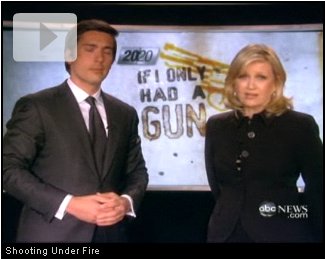
I suspected that I would regret it, but I did it anyway. I watched Diane Sawyer’s report, “If I Only Had a Gun,” on ABC’s 20/20 last night. I was expecting bias that would lean away from gun ownership and the right to arms, but what I saw was an hour of shamefully unadulterated propaganda.

I’m not naive when it comes to journalism. I’ve had my share of experience being misquoted, plagiarized, and editorially marginalized, but this was mainstream media bias in rare form. There were omissions, lies, and even fabricated evidence.

The broadcast sought to make four main points. Firearms are ineffective weapons for self-defense. Children are in grave danger of being killed by improperly stored firearms. “Gun violence” plagues a small town in Florida. Weapons can be obtained too easily through the “gun-show loophole.”

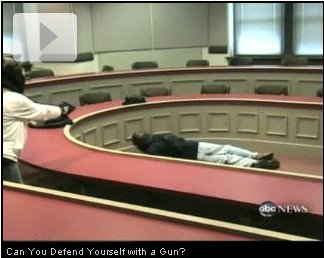
Can You Defend Yourself with a Gun?

The first segment dealt with carrying handguns for self-defense. To demonstrate that armed civilians are doomed to failure, ABC contrived a scenario designed to almost guarantee such failure. Posing as a deranged gunman, a well-trained police firearms instructor bursts into a small classroom and begins shooting simulated bullets. A barely trained college student wearing an awkwardly long shirt, bulky gloves, and cumbersome headgear is expected to engage this threat with his own mock handgun. Naturally, none of ABC’s handpicked subjects were able to make any quickly incapacitating shots. However, though this fact was minimized, one young woman did manage to deliver a probably fatal wound to the assailant’s femoral artery, which would have mitigated the casualties from his rampage as he rapidly bled to death on the classroom floor.

One hapless test subject scores a fatal hit.

Indeed, if someone walks up and immediately begins shooting you at close range, your chance to successfully defend yourself is already over, regardless of how well you may be armed. This applies even to well-trained police officers, who are far less common than ABC implied. Throughout the segment, video of intensive tactical training suggested that the average cop is a firearms expert. Unfortunately, standard police and even military firearms training is actually very basic. My own marksmanship skills are minimal, but even I have outperformed federal law-enforcement officers at the shooting range.

However, any honest right-to-arms advocate will tell you that a firearm is not a magic talisman that will guarantee your survival in a violent confrontation. Having a gun merely gives you a fighting chance, but that chance can be very small. I know that I would rather risk injury in defense of my loved ones than do nothing only to see them brutally murdered.

Extrapolating from this worst-case scenario that carrying a handgun can never help you in a violent encounter would be unwise at best, but this is exactly what ABC did. As further evidence, Diane Sawyer herself stepped up to a police simulator and failed to draw her sidearm quickly enough. Of course, that was a self-fulfilling prophecy, but don’t let her cover you in a potential firefight.

Diane Sawyer plays with guns.

In the end, ABC and Diane Sawyer were making a case that no one should be armed, not even the police. Of course, total disarmament is the ultimate goal of the gun-control movement. Despite their wishful thinking for a non-violent society, if the prohibitionists ever succeed, they would only turn the whole world back into Pahokee, Florida, as we will see in a moment.

When Older Kids Find Guns

The second segment explored the attraction guns hold for both younger and older kids. In another poorly constructed experiment, children were shown handling and playing with firearms placed where the kids would find them. Why this should surprise anyone is unclear.

A parent is shocked that her child would play with something.

Children are naturally curious. When adults try to hide something from them, they become even more eager to explore. The lure of forbidden fruit is a well-known phenomenon.

As usual, the answer is proper education. In the show, only the young man with gun-safety training resisted the temptation to improperly handle a found gun. The others all demonstrated their profound ignorance, though this occasionally had to be encouraged by ABC collaborators. Education saves lives.

Fortunately, accidental shooting deaths are actually very rare.

Damon Weaver’s Plea to Obama

Pahokee is a town of 6,000 souls, few jobs, and an “infinity of guns.” When darkness falls, the violence begins. Gangs rule this place, and by the light of day, the law-abiding residents are too frightened to help the police. Young, would-be journalist Damon Weaver asks what President Barack H. Obama will do to help his town.

Should a boy determine your civil rights?

Criminal gangs are the problem here. Criminals are already prohibited from having firearms, but one gang member boasts that he can get an illegal handgun for $60. When I legally purchased a police-surplus pistol for $350, I thought that was a smoking-hot deal.

Violent gangs are a problem older than human civilization. In fact, they are the problem that led us to form governments and states. We can no longer apply the historical military solutions, but until we put an end to the institutionalized poverty that encourages modern gangs and to the black markets that finance them, the problem will persist.

Firearms prohibitionists would unintentionally—or so I assume—return the whole world to the conditions of Pahokee, Florida. When the good people are disarmed, it will once again be the ruthless, violent gangs that dictate social policy. Violence as a means of conflict resolution is most effectively neutralized only when all sides are equally equipped to do violence.

I will answer little Damon’s question with my usual cynicism. President Obama will do nothing to help Pahokee. Doing so would be to reject the institutionalized poverty and paternalistic racism that is his party’s source of political power.

10 Guns in One Hour

The next myth that ABC promoted was the “gun-show loophole.” I have already written an article on this topic, but let me reiterate that there is no loophole. All federal, state, and local laws continue to apply at gun shows.

They worry about your private-property rights.

To illustrate their point, ABC gave $5,000 to the grieving brother of a Virginia Tech victim and sent him to a gun show in Richmond. Within an hour, the young man was able to buy 10 firearms (mostly old rifles and shotguns) from private parties at the show. He found some pretty good deals but nothing approaching the $60 stolen handguns in Pahokee.

Shooting Under Fire

The final segment wrapped up the rigged experiment that opened the broadcast. Diane Sawyer closed with this blatantly false statement: “… if you’re wondering where’re all the studies about the effectiveness of guns used by ordinary Americans for self-defense, well keep searching. We could not find one reliable study.…” Apparently, Ms. Sawyer and her “research” staff have never heard of libraries or even Google Scholar, where the ongoing academic discussion on the subject can be uncovered in less than five seconds … or maybe the facts didn’t support their predetermined conclusions.

Diane Sawyer lies on national television.

About the only thing that ABC and Diane Sawyer got right in this report is the fact that you are unlikely to be shot and even less likely to be shot fatally. A gunfight is one of the last places anyone should want to be, but having a gun does improve your odds of survival, according to federal crime data. That fact was nowhere to be seen in last night’s broadcast.

Firearms aren’t for everyone, but we have an inalienable right to arms. The U.S. Supreme Court has now recognized that fact. Nevertheless, the prohibitionists in the mainstream media clearly aren’t ready to abandon their propaganda campaign.

Monday, February 26, 2007

The Inconvenient Truth about Climatic Change

I am sure it came as no surprise when An Inconvenient Truth took the Oscar for best documentary feature at the 79th Academy Awards. This film joins the growing chorus sounding the alarm about the phenomenon of global warming. While I will stipulate that the global climate is indeed warming and that human activities play some part in the same, I must question the extent to which this is true and to which it is a problem and the advisability and wisdom of the proposed solutions.

The real inconvenient truth about climatic change is that it is a perfectly natural and normal process. A complex interplay of orbital, solar, biological, and geological factors causes our planet to cycle somewhat regularly between warmer and cooler periods. These cycles develop over approximately 40,000 to 100,000 years.

Currently, we are about 10,000 years into an interglacial period that may persist for another 20,000. Temperatures are generally increasing, and ice coverage is generally diminishing. Even so, there is still variation within the cycle. It was warmer about a thousand years ago, but it was colder just 400 years ago. The climate may very well be right where it is supposed to be, with human activities contributing little to an existing warming trend.

Technically, in fact, we are still in an ice age. In the more distant past, the global climate has been much warmer. Climatic change is a reality, and the biological history of our world has largely hinged on that fact. The only question is what we might do about it.

The assumption behind global-warming alarmism is that a warmer climate would be a bad thing. Sea levels would rise, weather patterns would change, and human civilization would be much disrupted. While such changes could surely be dramatic, I can’t say that they would all be negative.

In a warmer climate, vast tracts of the northern hemisphere would become more favorable to human habitation and agricultural development. The opening of the Northwest Passage would facilitate maritime trade. Perhaps the Sahara would become a verdant savanna once again. As with any change, there would be both positive and negative aspects.

Proposals to halt global warming, such as the Kyoto Protocol, raise still more difficult questions. If human-influenced climatic change is undesirable, is “natural” climatic change any more desirable? Do we stand by and do nothing when the climate “naturally” begins to cool again, starving our multitudes, crushing our cities under the ice, and land-locking our ports? Or do we try to keep things warm? If we decide that climatic control is a human prerogative, which ideal will we choose?

Furthermore, the proposals themselves often appear as much politically as ecologically motivated. Might they do more harm than the problem they are intended to correct? For example, the Kyoto Protocol is somewhat arbitrary in its application and almost seems to punish the developed nations, even though these are the ones working the hardest to reduce pollution and to mitigate environmental damage. This would also threaten to spread the institutionalized poverty that serves as the political power base for many of the parties that support the protocol.

Climatic change is an extremely complicated subject. More research and much more discussion should be undertaken before we begin to make rash decisions about controlling the global climate. We live in a dynamic system, and disrupting that system to maintain some arbitrary status quo may prove just as dangerous as pushing it toward an unknown outcome.

Setting climatic issues aside, however, there are still a number of reasons why we should clean up our act on hydrocarbons. Respiratory health and economic sustainability are just two more immediate and pressing considerations where the rampant use of hydrocarbons is concerned. Tackling these issues would be a safer and more effective strategy than doom saying about global warming.